When Will Stephen Collins Act Again
| St Stephen's Green | |
|---|---|
 Aerial view of St Stephen's Green | |
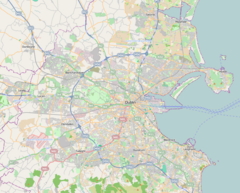
| St Stephen's Green Show map of Central Dublin St Stephen'south Dark-green Show map of Dublin St Stephen's Dark-green Show map of Ireland | |
 | |
| Blazon | City park |
| Location | Dublin, Ireland |
| Coordinates | 53°twenty′17″N vi°15′33″Due west / 53.33806°Due north 6.25917°W / 53.33806; -6.25917 Coordinates: 53°20′17″Northward half-dozen°15′33″W / 53.33806°N half-dozen.25917°West / 53.33806; -6.25917 |
| Area | viii.9 ha (22 acres) |
| Created | 1664 (1664) |
| Operated by | Office of Public Works |
| Status | Open all year |
| Public transit access | St Stephen's Green station |
| Website | ststephensgreenpark.ie |



St Stephen's Green (Irish: Faiche Stiabhna)[1] is a garden square and public park located in the city centre of Dublin, Ireland. The current mural of the park was designed by William Sheppard. It was officially re-opened to the public on Tuesday, 27 July 1880 past Lord Ardilaun.[two] [three] The foursquare is next to one of Dublin's main shopping streets, Grafton Street, and to a shopping centre named after information technology, while on its surrounding streets are the offices of a number of public bodies equally well every bit a cease on one of Dublin'southward Luas tram lines. It is often informally called Stephen's Green. At 22 acres (8.9 ha), it is the largest of the parks in Dublin's primary Georgian garden squares. Others include nearby Merrion Foursquare and Fitzwilliam Square.
The park is rectangular, surrounded past streets that once formed major traffic arteries through Dublin city eye, although traffic management changes implemented in 2004 during the course of the Luas works[4] have greatly reduced the volume of traffic. These iv adjoining streets are called, respectively, St Stephen's Greenish North, St Stephen'due south Light-green Due south, St Stephen's Green East and St Stephen's Green W.
History [edit]

Photochrom print showing the green at the end of the 19th century
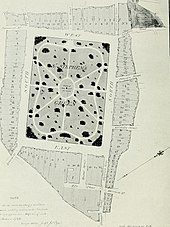
The clan with St Stephen has its origins in a medieval leper hospital, now Mercer's Hospital, dedicated to Saint Stephen on nearby Stephen Street. Until 1663, St Stephen'southward Light-green was a marshy common on the edge of Dublin of approximately lx acres, used for grazing. In that year Dublin Corporation, seeing an opportunity to raise much-needed revenue, decided to enclose the centre of the common and to sell land around the perimeter for building. The expanse was surveyed by Robert Newcomen, with the land divided into 96 plots with a light-green of 27 acres in the middle. The park was enclosed with a wall in 1664. Early tenants built simple two-storey houses, with much of information technology undeveloped on the 1728 map. By the time of John Roque's map in 1756, the pace of edifice had accelerated rapidly.[5] The houses built around the Dark-green were rapidly replaced by new buildings in the Georgian style and by the end of the eighteenth century the Light-green was a place of resort for the meliorate-off of the city. Most of the present-day mural of the square comprises townhouses from the 18th and 19th centuries.[6]
In 1814 command of St Stephen's Greenish passed to Commissioners for the local householders, who redesigned its layout and replaced the walls with railings.[7]
Afterwards the decease of Prince Albert, Queen Victoria suggested that St Stephen'southward Green exist renamed Albert Dark-green and accept a statue of Albert at its centre, a proffer rejected with indignation by the Dublin Corporation and the people of the city, to the Queen'south chagrin.[8]
Admission to the Green was restricted to local residents, until 1877, when Parliament passed an Act to reopen St Stephen'southward Green to the public, at the initiative of Sir A.E. Guinness, a member of the Guinness brewing family who lived at St Anne'southward Park, Raheny and at Ashford Castle. He later paid for the laying out of the Dark-green in approximately its current course, which took place in 1880, and gave it to the Corporation, equally representatives of the people. Past fashion of thank you, the city commissioned a statue of him, which faces the College of Surgeons. His blood brother Edward lived at Iveagh House, which his descendants gave in 1939 to the Section of External Affairs (at present the Section of Foreign Affairs).
During the Easter Rising of 1916, a group of rebels made up mainly of members of the Irish Citizen Regular army, under the control of Commandant Michael Mallin, his second-in-command Kit Poole, and Constance Markievicz, established a position in St Stephen's Green.[nine] They numbered between 200 and 250.[10] They confiscated motor vehicles to establish roadblocks on the streets that surround the park, and dug defensive positions in the park itself. This approach differed from that of taking up positions in buildings, adopted elsewhere in the city. It proved to accept been unwise when elements of the British Ground forces took up positions in the Shelbourne Hotel, at the northeastern corner of St Stephen's Light-green, overlooking the park, from which they could shoot down into the entrenchments.[9] Finding themselves in a weak position, the Volunteers withdrew to the Purple College of Surgeons on the due west side of the Green.[x] During the Rising, gunfire was temporarily halted to allow the park'due south groundsman to feed the local ducks.[11]
The park is at present operated past the Office of Public Works (OPW) on behalf of the Irish state.[12]
Park [edit]
Development of design [edit]

St Stephen's Dark-green fountain in summer
The landscaping of the park has undergone iii major changes since its inception. Its commencement major alter occurred in 1670: two rows of lime copse were planted effectually the perimeter, functioning as its first enclosure. The marshy basis was drained using a ditch at the perimeter.[xiii] At this time, the park was just attainable to the wealthy residents who endemic plots around the park. In 1815 the park was redesigned by the Dublin city surveyor Arthur Neville. In his redesign, he added winding pathways and iron fences. At this time, the park was still airtight to the public.[ii]
During the 1860s, the entrada to make the park publicly accessible was underway, and the city engineer, George W. Hemans,[xiv] proposed a new pattern to make the park as walkable and every bit functionally applied equally possible. This included creating iv gates at each corner of the park that would be linked by the extant pathways designed past Neville. This programme was eventually abandoned, most likely due to the fact that Hemans was employed by Dublin Corporation. However, many of Hemans' designs, like the improver of the gates and connecting pathways, were included in the last plans submitted past William Sheppard, the main designer responsible for the mural of the park every bit we know it today, and engineer A.50. Cousins, sponsored past Lord Ardilaun. Ardilaun also played a significant role in the planning and importing of the exotic trees and plants that would exist installed in the park.[2]
Layout [edit]
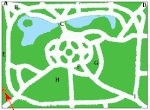
Map of Green with some central features: (A) Fusiliers' Arch (B) O'Donovan Rossa (C) O'Connell Span (D) WolfeTone & Famine Memorial (East) Lord Ardilaun (F) Markievicz (1000) Playground (H) Bandstand (I) Three Fates

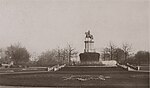
Statue of George II, which stood from 1758 to 1937
While the central park of St Stephen'southward Green is 1 of iii aboriginal commons in the city, its current layout owes much to the restorations of the 19th century. Architectural history professor Christine Casey states that this restoration obscures what would take been its most impressive feature to 18th-century visitors, its large size.[thirteen] The grounds are roughly rectangular, measuring (approximately) 550 by 450 metres, and are centred on a formal garden.
Past 1758, the tree-lined walks around the park had been named, Beaux Walk to the north, Leeson's Walk to the southward, Monck's Walk to the east, and French Walk to the due west.[thirteen]
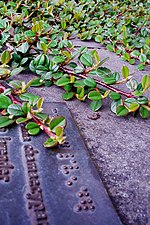
One of the more unusual aspects of the park lies on the northwest corner of this central surface area, a garden for the bullheaded with scented plants, which can withstand handling, and are labelled in Braille.
Farther north once more (and spanning much of the length of the park) is a large lake. Home to ducks and other water fowl, the lake is fed past an artificial waterfall, spanned past O'Connell bridge, and fronted by an ornamental gazebo. The lakes in the park are fed from the Grand Canal at Portobello.
To the south side of the main garden circle is more open up heath surrounding a bandstand, and often frequented by lunching students, workers and shoppers on Dublin's sunnier days.
In that location is also a playground (separated into junior and senior areas) which was refurbished in 2010.
The park once featured a statue of Male monarch George II on horseback by John van Nost,[13] erected in 1758, until it was diddled upwardly in 1937 by Irish Republicans, the 24-hour interval after the coronation of George VI.[xv] [16]
Other notable features include:
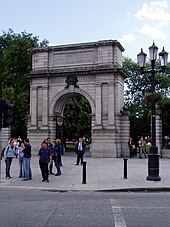
- the Fusiliers' Curvation at the Grafton Street corner which commemorates the Royal Dublin Fusiliers who died in the Second Boer War.
- a fountain representing the Three Fates inside the Leeson Street gate. The statue was designed by Joseph Wackerle in bronze in 1956. It was a gift from the German language people in cheers for Irish gaelic help to refugee children following World War II. Up to 5 hundred children institute foster homes in Ireland in a project named Operation Shamrock.
- a seated statue of Lord Ardilaun on the western side, the man who gave the Green to the city, facing the Imperial College of Surgeons which he also sponsored (again, encounter History above)
- the Yeats memorial garden with a sculpture by Henry Moore
- a bust of James Joyce facing his one-time university at Newman Business firm
- a memorial to the Fenian leader Jeremiah O'Donovan Rossa near the Grafton Street entrance
- a statuary statue at the Merrion Row corner of Theobald Wolfe Tone, the leader of the 1798 rebellion.
- a memorial to the Corking Famine of 1845–1850 by Edward Delaney
- a bust of Constance Markievicz on the s of the central garden (encounter History above)
- a statue of Robert Emmet standing opposite his birthplace (now demolished) at No 124.
- a memorial bosom of Thomas Kettle, a fatality of the Great War. The effort to erect a commemorative portrait bust of Kettle was beset past controversy until it was finally placed, without official unveiling, in the centre section.
Compages [edit]
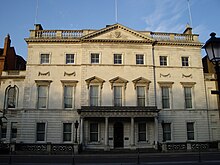
Some of the earliest houses still survive on the southward and north sides of the Green. These are identifiable past their lower height and narrow fronts, illustrating how plots were subdivided. Later buildings on the east side show a dramatic change in calibration, with much larger and grander houses, many by Gustavus Hume.[17]
Iveagh House on the south side was created from the joining of two before houses (numbers fourscore and 81) past Benjamin Guinness in the 1860s. It was donated to the Irish gaelic State by the Guinness family in 1939, and now houses the primary offices of the Department of Strange Affairs.
Too on the s side of St Stephen's Greenish are Newman House (numbers 85 and 86, after John Henry Newman) and University Church. These are home to the Catholic University of Ireland, which was founded in the 19th Century. Information technology is linked with University Higher Dublin, but is no longer active educationally in its own right.
The Unitarian Church building, Dublin, congenital in the Gothic revival style, is located on the W side of St Stephen'southward Greenish.[xiii]
Likewise on the westward side is the Regal College of Surgeons in Ireland (number 123),[13] home to the oldest of the Republic of Ireland's six medical schools.
On the west side, at the elevation of Grafton Street, is the Stephen's Green Shopping Heart, built in October 1988. It was, at the time, Ireland'south largest shopping centre. Its style was intended to represent a conservatory on the side facing the Green and to mirror the brickwork design of the opposing Gaiety Theatre on South King Street.
On the north side of St Stephen'due south Green, at that place were four houses which are now two clubs (originally gentlemen's clubs): the Hibernian United Services Club (number 8, airtight in 2002), the Stephen'southward Green Hibernian Order (number nine, originally the Stephen's Greenish Club, prior to its merger with the Hibernian United Services Club), the "Friendly Brothers of St Patrick" (number 22, now closed) and the Kildare Street and University Club (number 17). This side of the Dark-green also has the historic Shelbourne Hotel, Dublin'south only surviving Victorian hotel.[13] The Little Museum of Dublin, which is housed in a restored Georgian townhouse.
Too on the north side, Heritage House at 23 St Stephen'southward Green, was the location of a tearoom which hosted the first public Alcoholics Anonymous meeting in Republic of ireland, on 25 Nov 1946.[18] [19]
Loreto College, St Stephen's Green, ane of Ireland'south best-known fee-paying schools for girls, is located at number 53, on the East side of the Dark-green.
St Vincent's Hospital, now located in a suburb on the due south side of Dublin, was formerly located in buildings on the Due east side of St Stephen's Green and on Leeson Street.
During the mid 20th century, a number of the Georgian buildings on the Green were demolished in favour of modern role blocks. Most of the due east side of the square is modern reproduction terraces in front of offices.[xiii] Among the buildings that were lost was No. 21, the quondam St Andrew's Higher, which was demolished by Irish Life in February 1969 and a new office block, Stephen Court, designed by Andrew Devane was constructed in its place. This building is deemed 1 of the more successful modern interventions on the Green.[20]
Ship [edit]
Dublin Bus routes 7b, 7d, 11, 32x, 37, 41x, 44, 46a, 61, 84x, 145, 155 and 757 all have stops along the due east side of the square.
The Light-green line of the Luas tram system stops at the St Stephen'due south Green cease on the western side of the park, with Luas Cross Urban center services continuing to Broombridge station in Cabra.[21] [22]
Come across also [edit]
- List of streets and squares in Dublin
References [edit]
Notes [edit]
- ^ "Sraidainmneacha Bhaile Atha Cliath" (PDF). Dublin City Council. Archived (PDF) from the original on 5 Dec 2014. Retrieved xxx November 2014.
- ^ a b c "Report on St Stephen's Dark-green" (PDF). UCD School of Archaeology. Archived (PDF) from the original on five December 2014. Retrieved 14 April 2012.
- ^ "Heritage Ireland: St Stephens Green". world wide web.heritageireland.ie. Archived from the original on ane December 2014. Retrieved 25 September 2017.
- ^ "Roadworks on St Stephen'due south Green to reverse traffic flow and restrict movement". The Irish Times. half dozen June 2004. Archived from the original on xx May 2011. Retrieved 30 November 2014.
- ^ Casey 2005, p. 531.
- ^ "National Inventory of Architectural Heritage". Archived from the original on 14 April 2021. Retrieved 31 January 2021.
- ^ "Archiseek.com – St Stephen's Dark-green, Dublin". Archiseek.com. Archived from the original on xi January 2008.
- ^ "A queen'south welcome: Victoria'south stormy affair with Ireland". Irish Examiner. 26 June 2010. Archived from the original on eighteen September 2012. Retrieved 3 December 2010.
- ^ a b Casey 2005, p. 533.
- ^ a b "The 1916 Ascent: Personalities and Perspectives – Stephens Light-green" (PDF). National Library of Ireland. Archived from the original (PDF) on 6 Nov 2015. Retrieved 30 November 2014.
- ^ Michael O'Sullivan, Bernard O'Neill: The Shelbourne and its people (Blackwater Press 1999), p.45 ISBN i-84131-442-0
- ^ "OPW Heritage Ireland Site – St Stephens Green page". HeritageIreland.ie (OPW). Archived from the original on 1 December 2014. Retrieved 30 November 2014.
- ^ a b c d e f yard h Casey 2005, p. 532.
- ^ "Dictionary of Irish Architects - HEMANS, GEORGE WILLOUGHBY". Dia.ie. 13 November 1926. Archived from the original on 31 December 2013. Retrieved 28 December 2013.
- ^ Carpenter, Andrew, ed. (1998). Verse in English from Eighteenth-century Republic of ireland. Cork University Press. ISBN9781859181034. Archived from the original on 26 August 2021. Retrieved 3 October 2020.
- ^ Chastel-Rousseau, Charlotte, ed. (2011). Reading the Royal Monument in Eighteenth-century Europe. Ashgate Publishing. ISBN9780754655756.
- ^ Casey 2005, p. 531-532.
- ^ "A Catholic Members Appreciation". Furrow Mag. November 1953. Archived from the original on 1 Jan 2011. Retrieved 15 Dec 2020 – via a-1associates.com.
- ^ "News Sheet" (PDF). alcoholicsanonymous.ie. Oct 2016. Archived (PDF) from the original on 26 July 2021. Retrieved 15 December 2020.
- ^ McDonald 1985, p. 81-82.
- ^ "Green light given to Luas link-up, offset passengers 2022 – RTÉ News". Rte.ie. 3 Baronial 2012. Archived from the original on v August 2012. Retrieved xxx Baronial 2012.
- ^ "Taoiseach launches new Luas Cross City service in Dublin". RTÉ. nine December 2017. Archived from the original on ix December 2017. Retrieved 9 December 2017.
Sources [edit]
- Casey, Christine (2005). Dublin: The Urban center Inside the Chiliad and Royal Canals and the Circular Route with the Phoenix Park. Yale University Press. ISBN978-0-30010-923-eight.
- McDonald, Frank (1985). The Destruction of Dublin. Gill and MacMillan. ISBN0-7171-1386-8.
External links [edit]
- Stephen's Green Park (official OPW website)
mascarenasahme1941.blogspot.com
Source: https://en.wikipedia.org/wiki/St_Stephen%27s_Green
Belum ada Komentar untuk "When Will Stephen Collins Act Again"
Posting Komentar