Have All the Neccary Asset Paths to Continue the Development
Since 2012, Search Institute has asked young people to report their sexual orientation and gender identity on its survey, Attitudes & Behaviors, The inclusion of these items offers the first available data on the Developmental Assets of LGBT youth. Between 2012 and 2015, 12,262 lesbian, gay, bisexual, and transgender (LGBT) youth participated in the survey.
A NOTE ABOUT THIS RESEARCH: Although each of the subgroups of young people within the LGBT community have different life experiences, we present aggregate data of LGBT youth and, in many cases, data for the broader categories of lesbian/gay, bisexual, and transgender youth.
This high-level disaggregation highlights the need for deeper examination of more fine-grained explorations, including intersectionality issues of sexual orientation, gender identity, race/ethnicity, socioeconomic status, and other individual differences. Some of these issues are being examined in ongoing analyses of this dataset.
DATA SHEET: Developmental Assets among LGBT Youth (PDF)
Key Findings
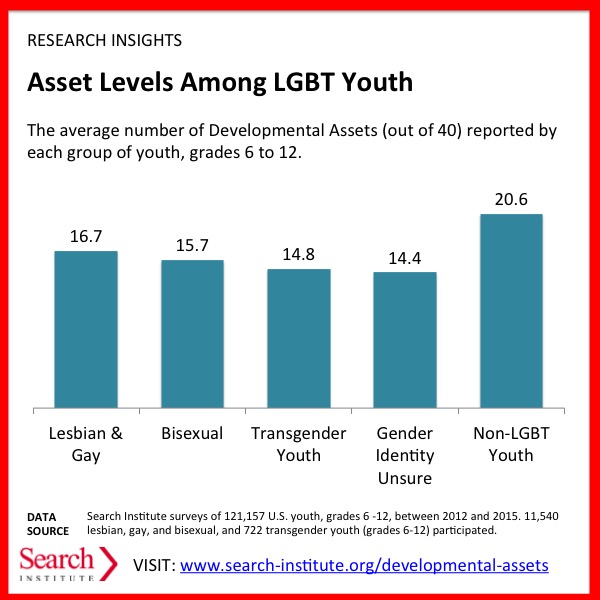
- Level of assets— Lesbian and gay youth in this sample report an average of 16.7 assets out of 40. Bisexual youth report an average of 15.7 assets, transgender youth report an average of 14.8 assets. Non-LGBT youth report an average of 20.8 assets.
- Challenges— About one in four LGBT youth experience several assets, including a caring neighborhood (24-28%, for different subgroups of youth: lesbian/gay, bisexual, and transgender), parent involvement in schooling (21-22%), positive family communication (19-21%), adult role models (16-21%), youth as resources (16-19%) and community values youth (12%).
In addition, LGBT youth report lower levels of many individual assets when compared to other youth, and transgender youth tend to have lower asset levels than lesbian, gay, and bisexual youth. The assets with the largest gaps between LGBT youth and non-LGBT youth are:
- Sense of purpose (32% among LGB youth and 34% among transgender youth, compared to 63% non-LGBT youth);
- Self-esteem (25% among LGB youth and 28% among transgender youth, compared to 50% among non-LGBT youth);
- Positive view of personal future (55% among LGB youth and 48% among transgender youth, compared to 74% among non-LGBT youth); and
- Family support (55% among LGB youth and 49% among transgender youth compared to 75% among non-LGBT youth).
These findings echo the well-documented risks and challenges faced by LGBT youth. In addition, these findings highlight that LGBT youth do not experience the levels of supports and opportunities that, on average, non-LGBT youth experience. In addition, many LGBT youth experience major changes that occur in their relationships and their own sense of themselves when they come out. These times of transition represent important opportunities for reinforcing or rebuilding positive supports and opportunities.
- Strengths— Although our society often focuses on the risks for LGBT youth, it is also important to remember the strengths they experience and the resources present in their lives. A majority of LGBT youth experience a number of developmental assets, including integrity (63-76%), achievement motivation (49-64%), time at home (57-64%), equality and social justice (48-63%), honesty (50-61%), and positive peer influence (54-60%). In addition, LGBT youth reported higher levels than non-LGBT of a few assets:
- Reading for pleasure (33% among LGB youth and 32% for transgender youth, compared to 21% among non-LGBT youth); and
- Creative activities (27% of LGB youth and 29% among transgender youth, compared to 19% among non-LGBT youth).
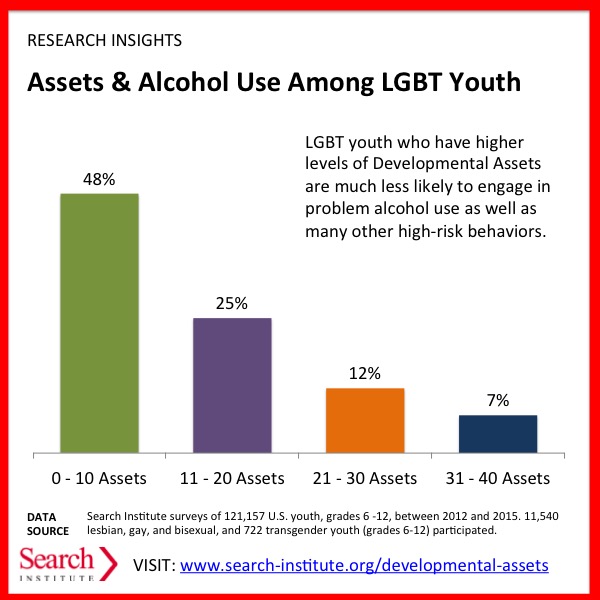
- Prevention— Like their peers, LGBT youth who have more assets are much less likely to engage in a wide range of high-risk behaviors. For example, 56% of LGBT youth who report 0-10 assets report having attempted suicide, compared to 11% of those who report having 31-40 assets.
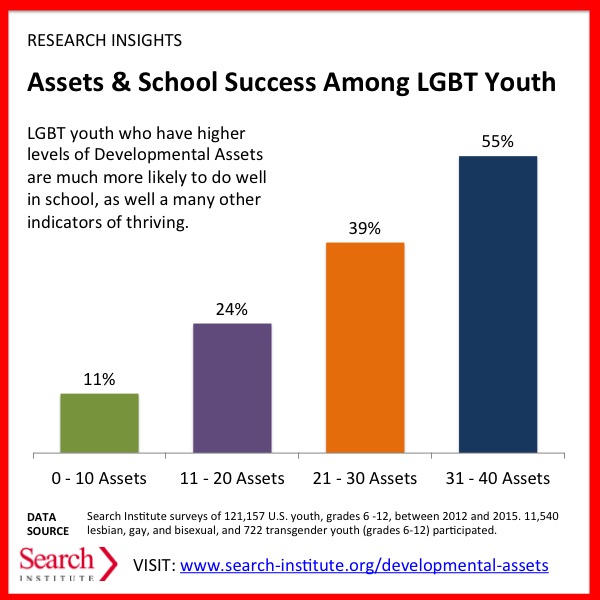
- Promotion— LGBT youth who have more assets are much more likely to engage in thriving behavior. For example, 20% of LGBT youth who report 0-10 assets maintaining good health behaviors (e.g., exercise, diet), compared to 83% of those who report having 31-40 assets.
Taking Action
Assets are strengthened through relationships and supports from families, peers, teachers, program leaders, and other adults in young people's lives. LGBT youth experience fewer of these supports and relationships—many of which may have been stressed or even disrupted when these youth identified as LGBT. In many communities, LGBT youth face ongoing stigma and discrimination, which further undermine their experiences of Developmental Assets as well as other elements of well-being.
Recognizing the gap in assets for LGBT youth opens opportunities to form strong developmental relationships with these young people, getting to know them for who they are and who they are becoming. It also calls on schools, organizations, and communities to provide the kinds of opportunities, role models, and supports that LGBT youth need to learn, grow, and thrive.
At the same time, many LGBT youth experience strong foundations of assets, and they grow up thriving, even in the midst of challenges. Noticing and celebrating these strengths has potential to reframe biases and assumptions that focus only on risks. It recognizes resilience in the face of challenges and strengths to live with purpose, promise, and possibilities.
Related research: Search Institute is currently conducting in-depth data analysis of the assets of LGBT youth , particularly focusing on the role of assets in suicide prevention among LGBT youth.
mascarenasahme1941.blogspot.com
Source: https://www.search-institute.org/our-research/development-assets/current-research-developmental-assets/
Belum ada Komentar untuk "Have All the Neccary Asset Paths to Continue the Development"
Posting Komentar